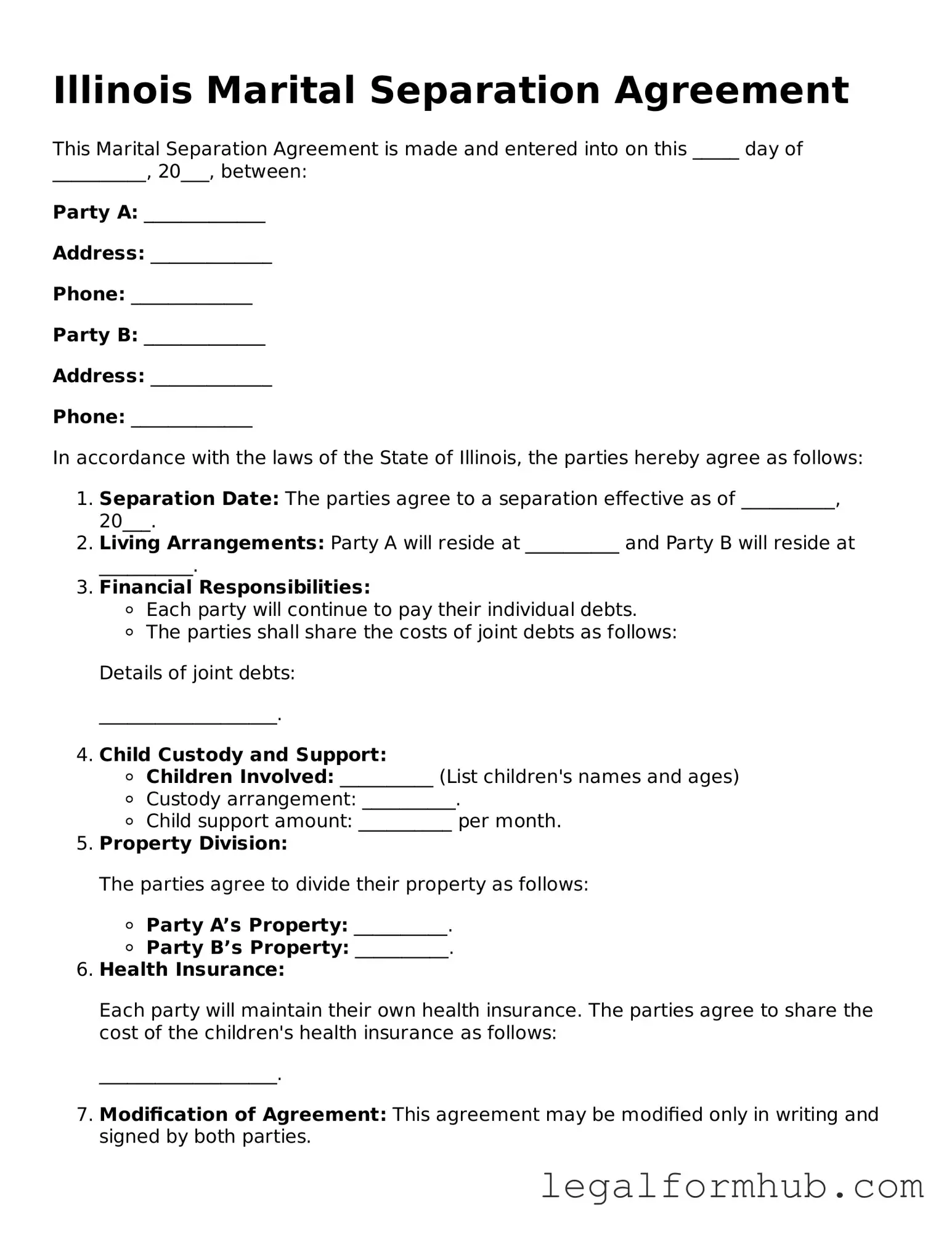
Free Marital Separation Agreement Template for Illinois
Create Other Popular Marital Separation Agreement Forms for Different States
Legal Separation in Texas Forms for Free - A legally crafted agreement can reduce the likelihood of future disputes.
Legal Separation in Georgia With Child - Encourages responsible and thoughtful decision-making.
Marital Settlement Agreement California - The agreement may specify conditions under which one partner may occupy the marital home.
Having a solid understanding of the Arizona Motorcycle Bill of Sale is vital for anyone engaging in the sale or purchase of a motorcycle, as it serves to protect both parties involved. For those looking to simplify the process, a useful resource can be found at arizonapdfs.com/motorcycle-bill-of-sale-template/, which provides a template to ensure all necessary details are included in the transaction.
How to File for Legal Separation in Michigan - It serves as a framework for addressing child custody and support issues.
Similar forms
The Illinois Marital Separation Agreement is similar to a Divorce Settlement Agreement. Both documents outline the terms of a couple's separation, including the division of assets, child custody arrangements, and support obligations. While the Marital Separation Agreement is used when the couple intends to live apart but not necessarily end the marriage, the Divorce Settlement Agreement is finalized when the couple decides to dissolve their marriage. Each document serves to protect the interests of both parties and provide clarity on their respective rights and responsibilities.
Another comparable document is the Legal Separation Agreement. Like the Marital Separation Agreement, this document allows couples to live separately while remaining legally married. It details the same aspects, such as property division and child support. However, a Legal Separation Agreement often requires court approval, whereas a Marital Separation Agreement can be more informal and private. Both agreements aim to help couples navigate their new living arrangements and responsibilities.
The Cohabitation Agreement shares similarities with the Marital Separation Agreement, particularly regarding financial matters and responsibilities. Couples who choose to live together without marrying may use this document to outline how they will share expenses, property, and other assets. While the Marital Separation Agreement focuses on separating a married couple's interests, the Cohabitation Agreement addresses the needs of unmarried partners, ensuring clarity and protection for both parties.
As you consider the various agreements that can accompany a separation or divorce, it is essential to approach each document with care to ensure that all terms are clear and agreed upon. For those who are entering into a vehicle transaction, an equally important document is the Fill PDF Forms, which outlines the specifics of the purchase and protects both buyer and seller.
A Prenuptial Agreement also resembles the Marital Separation Agreement, as both documents deal with the division of assets and financial responsibilities. A Prenuptial Agreement is established before marriage, outlining how assets will be divided in the event of a divorce or separation. In contrast, the Marital Separation Agreement addresses these issues after the couple has already married and decided to separate. Both documents aim to provide a clear understanding of each party's rights and obligations.
The Property Settlement Agreement is another document similar to the Marital Separation Agreement. This document focuses specifically on the division of property and assets between spouses. It can be used during a divorce or separation process to clarify how marital property will be divided. While the Marital Separation Agreement may encompass a broader range of topics, including child custody and support, the Property Settlement Agreement hones in on financial matters, making it a crucial part of the separation process.
Additionally, the Child Custody Agreement is closely related to the Marital Separation Agreement, especially in cases where children are involved. This document outlines the custody arrangements, visitation schedules, and child support obligations for parents who are separating. While the Marital Separation Agreement may address these issues, the Child Custody Agreement specifically focuses on the best interests of the child, ensuring that their needs are prioritized during the separation process.
Lastly, the Separation Notice can be compared to the Marital Separation Agreement. This document is typically filed with the court to formally notify the other spouse of the intent to separate. It serves as a precursor to more detailed agreements, such as the Marital Separation Agreement. While the Separation Notice is a more straightforward document, it sets the stage for further negotiations and agreements regarding the couple's future arrangements and responsibilities.
Instructions on Writing Illinois Marital Separation Agreement
After obtaining the Illinois Marital Separation Agreement form, it is essential to fill it out accurately to ensure that all necessary information is included. This document will serve as a record of the terms agreed upon during your separation. Following the steps outlined below will help you complete the form efficiently.
- Begin by entering the date at the top of the form.
- Provide your full legal name and the name of your spouse in the designated spaces.
- Indicate the date of your marriage.
- List the date you separated.
- Describe the arrangements for child custody, if applicable, including physical and legal custody details.
- Detail any child support obligations, including the amount and payment schedule.
- Outline the division of property and debts, specifying what each party will retain.
- Include any spousal support or alimony agreements, if relevant.
- Sign and date the form at the bottom, ensuring both parties do the same.
- Make copies of the completed form for your records and for your spouse.
Once the form is filled out and signed, it is advisable to consult with a legal professional to review the document before submitting it to the appropriate court. This step can help ensure that your rights are protected and that the agreement is enforceable.
Misconceptions
When it comes to the Illinois Marital Separation Agreement form, several misconceptions can lead to confusion for individuals navigating their separation. Understanding these misunderstandings is crucial for making informed decisions. Below are six common misconceptions:
- Misconception 1: A marital separation agreement is the same as a divorce.
- Misconception 2: The separation agreement is not legally binding.
- Misconception 3: A separation agreement only addresses child custody.
- Misconception 4: You do not need an attorney to create a separation agreement.
- Misconception 5: Separation agreements cannot be modified.
- Misconception 6: You cannot file for divorce until the separation agreement is finalized.
While both documents deal with the dissolution of a marriage, a marital separation agreement allows couples to live apart without legally ending their marriage. Divorce finalizes the marriage, while separation is a temporary arrangement.
Many believe that a marital separation agreement holds no legal weight. However, once both parties sign the agreement, it becomes a legally enforceable contract, provided it meets certain legal requirements.
Some individuals think that these agreements only cover child-related issues. In reality, they can also address property division, spousal support, and other financial matters, making them comprehensive documents.
While it is possible to draft a separation agreement without legal assistance, consulting with an attorney is highly advisable. An attorney can ensure that the agreement complies with Illinois law and protects your interests.
Some people believe that once a separation agreement is signed, it cannot be changed. In fact, if both parties agree, modifications can be made to reflect new circumstances or needs.
It is a common belief that one must finalize a separation agreement before filing for divorce. However, individuals can file for divorce at any time, even while negotiating the terms of their separation agreement.
Key takeaways
When filling out and using the Illinois Marital Separation Agreement form, keep these key takeaways in mind:
- Understand the Purpose: The agreement outlines the rights and responsibilities of both spouses during separation.
- Complete All Sections: Fill out every section of the form thoroughly to avoid delays or complications.
- Consider Legal Advice: Consulting with a lawyer can provide clarity and ensure your rights are protected.
- Be Clear and Specific: Clearly state terms regarding property division, child custody, and support to prevent misunderstandings.
- Review State Laws: Familiarize yourself with Illinois laws related to marital separation, as they can impact your agreement.
- Sign in Front of Witnesses: Both parties should sign the agreement in the presence of witnesses to validate it.
- Keep Copies: Make multiple copies of the signed agreement for both parties and any relevant institutions.
- File with the Court: If necessary, file the agreement with the appropriate court to make it enforceable.
- Update as Needed: Revisit and update the agreement if circumstances change, such as income or living arrangements.
File Overview
| Fact Name | Description |
|---|---|
| Purpose | The Illinois Marital Separation Agreement outlines the terms of separation between spouses, addressing issues like property division, debt responsibility, and child custody. |
| Governing Law | This agreement is governed by the Illinois Marriage and Dissolution of Marriage Act. |
| Voluntary Agreement | Both parties must voluntarily agree to the terms outlined in the agreement. It is essential that both spouses understand and consent to the provisions. |
| Legal Binding | Once signed, the agreement is legally binding and enforceable in court, provided it meets all legal requirements. |
| Modification | The agreement can be modified in the future if both parties consent to the changes and document them appropriately. |